
Teamcast: Collaborative Forecasting
Built for algo-traders, flex-traders, and BESS optimizers who want to know
who is really the smartest in the room.
Teamcast sources, aggregates, and benchmarks price spread forecasts
for the European short-term power and capacity markets.
Frequently Asked Questions:
Who should use FlexUp Teamcast?
Teamcast is for power price forecasters, power traders, analysts, BESS optimizers and investors who rely on short-term price forecasts to understand short-term power markets. It helps teams compare different forecasting approaches, track performance over time, and turn many individual views into one transparent “consensus” forecast.
Why forecasters use FlexUp Teamcast?
Forecasters use Teamcast to:
Compare your results to your peers’ to understand how accurate your models’ forecasts are.
Showcase your results to forecast consumers, such as traders and BESS optimizers, to attract new customers.
Earn money from being included in the Teamcast Consensus Forecast data stream.
Why traders use FlexUp Teamcast?
Traders use Teamcast to:
Gain a transparent, apples-to-apples comparison of forecasting accuracy.
Understand how your in-house perspective on tomorrow’s markets compares with other views
Find unique, socially-sourced, highly-contextual time-series data to further optimize your models and trading algorithms
How does FlexUp Teamcast work?
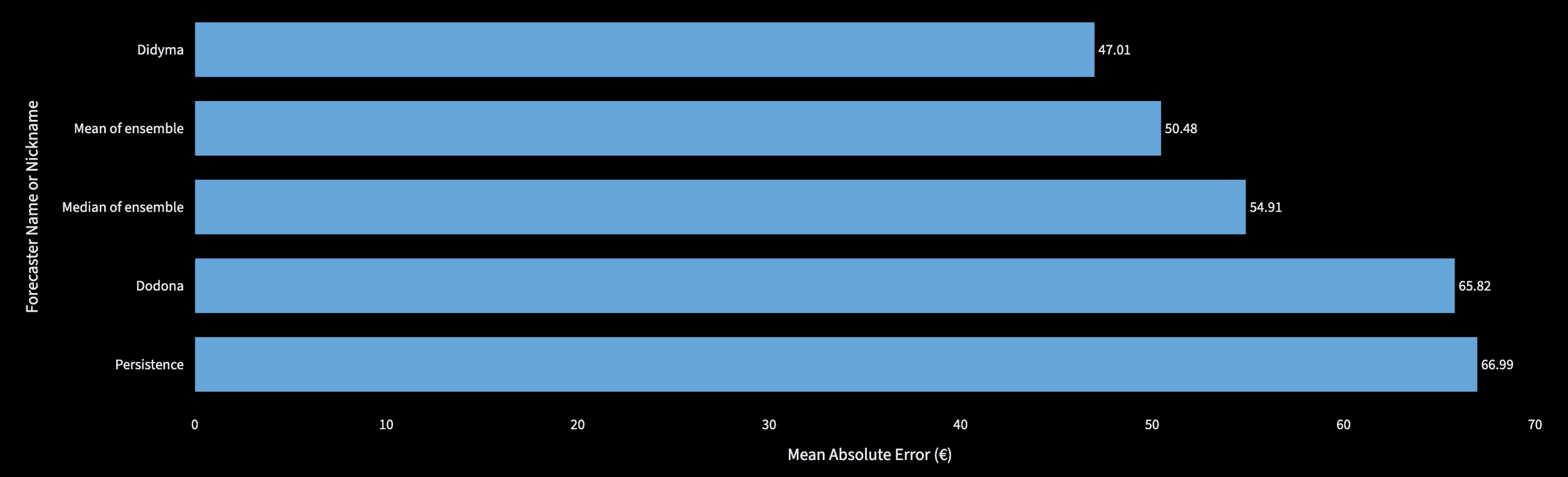
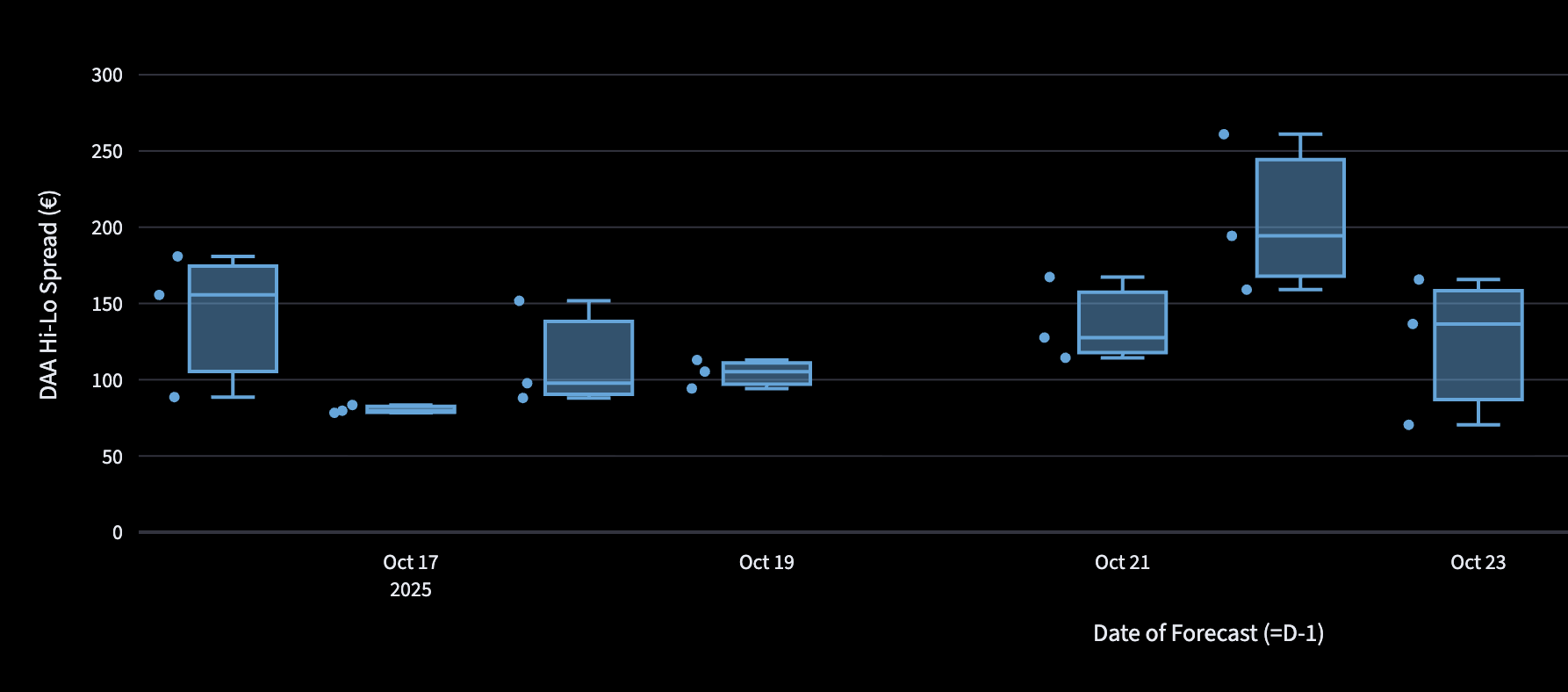
Forecasters submit daily price forecasts, currently just for a single target variable: the DE-LU day-ahead-auction Hi-Lo spread. Teamcast makes the resulting “crowd-sourced-ensemble” available before the FCR gate closure every day (so the data can inform traders’ perspective on expected volatility, energy-arbitrage-margins, and resulting optimal FCR bids). After the DAA results are public, Teamcast evaluates the forecasts against actual market outcomes, scores and ranks their accuracy, and visualizes the ranking daily.
Does this “crowd-ensemble-forecast” replace my current provider’s and/or in-house price forecast?
No! The market requires each participant to develop and trade on their own perspective. However, as a trader, understanding how your perspective compares with other views can improve decision making. Teamcast’s “crowd-sourced ensemble” forecast is therefore intended as a complement to your current / in-house market perspective, adding an additional, wider perspective your in-house and externally sourced forecasts.
Can Teamcast compare multiple forecasting approaches (e.g. different models, weather-models, or external providers)?
Yes. Teamcast is built to compare many “streams” of forecasts: different people, models, vendors, or even entire trading desks. Each stream gets its own ID and performance history, so you can see at a glance who systematically outperforms, in which products and horizons, and build a stronger ensemble from the best components. We also perform structured backtest comparisons, comparing how different forecasts affect trading margins of different trading strategies / algorithms.
Can I input my own price forecast or model output?
Yes. Teamcast is designed so that you can upload or connect your own forecasts streams. They’ll be treated like any other participant: evaluated, scored, and included in the ensemble and comparison views. This will increase the market visibility of your forecasts and their accuracy.
Does Teamcast benchmark historical forecasting performance?
Yes. Historical performance benchmarking is a core feature: Teamcast stores past forecasts and compares them to realized prices, so you can look back over weeks, months, and years. This gives you a stable, “apples-to-apples” view of which forecasts consistently outperform and how robust different approaches are. We run in-depth forecast comparison and benchmarking projects for traders and forecasters alike.
Can Teamcast integrate with external systems?
Initially, Teamcast is available as a web-based interface and datasets for backtesting. We are working on light-weight APIs and Python-friendly integrations so that you can send and receive forecasts automatically from your existing tools and pull back scores, statistics, and consensus forecasts into your own environment. Contact us for beta-access.
Where can I learn more about the FlexUp Teamcast roadmap?
Just contact us with your use case or requirements. We’re happy to share the current roadmap, discuss upcoming features (e.g. API design, next target variables to add, next forecast models to add), and explore pilot collaborations.
What are the names on the Teamcast Benchmarking graph?
The forecast names on the Teamcast benchmarking graph are pseudonyms for forecast contributors. They reflect each participant’s chosen anonymity level:
* Level 1 – Fully anonymous: Results in the ensemble, shown only under a Greek name. Not listed by real name.
* Level 2 – Partially disclosed: Specific results under a Greek name; forecaster real name/company appears in the participant list, but not linked to a specific Greek name.
* Level 3 – Fully disclosed: Specific results under to the forecaster’s real name/company.
In short: Greek names are stable aliases that let you control how visible you are while still being benchmarked.
How is the Ensemble calculated?
The ensemble hi-lo spread (variable) is the mean or median of the individual forecast variables that make up the ensemble. The absolute error of the ensemble is the absolute difference between the ensemble variable and the actual.
How much does Teamcast cost?
Teamcast is currently open-source (view github repo) and participation is free, both for forecasters and traders. We intend to offer paid API access in the future.